Sausage Saloon - Case Study
See how Sausage Saloon's Mall of the South pilot used Servantage to boost ratings, measure frontline service, and plan a national rollout.

A Data-Led View of Frontline Service
For retail and restaurant operators, managing frontline service quality often relies on anecdotal feedback or delayed mystery shopper reports. The recent Servantage pilot at Sausage Saloon’s Mall of the South location demonstrates a more effective approach: turning everyday customer interactions into actionable management information.
By equipping staff with Servantage's staff-linked QR lanyards and NFC tags, Sausage Saloon was able to capture immediate customer ratings and comments, connecting this feedback directly to individual employees and specific service touchpoints. This case study explores the pilot's performance, the impact on local search visibility, and the strategic proposition for a national rollout.
Immediate Impact on Local Brand Visibility
One of the most immediate benefits of the Servantage system is its ability to route highly satisfied customers toward public review platforms while capturing critical feedback internally for service recovery. Over the span of just three weeks, the Sausage Saloon Mall of the South store saw its rating increase from 3.3 to 4.59 stars.
This demonstrates how a structured frontline measurement system not only improves internal operational intelligence but also directly influences digital footfall and local search reputation.
Pilot Performance at a Glance
The pilot dashboard yielded a live stream of customer feedback, capturing 250 verified ratings and interactions. The data provides a clear, quantitative picture of store performance over the period:
Average Customer Star Rating: 4.81 / 5 (with 226, or 90%, being five-star ratings).
Servantage Service Index (SSI): 4.59 / 5, providing a confidence-adjusted internal service measure distinct from the raw star average.
Frontline Index: 92 / 100, serving as the headline frontline performance indicator.
Favourable Sentiment: 96%, showing overwhelmingly positive customer sentiment.
Response Rate: 60%, indicating strong customer participation and engagement with the QR and NFC touchpoints.
Additionally, the dashboard recorded 100% positive responses for four critical service moments: customers felt welcomed, had their needs understood, had menu items clearly explained, and had issues resolved. While these specific touchpoint metrics represented a smaller sample size of five answers per item, they serve as valuable early signals rather than statistically stable performance measures, providing a strong foundation for future benchmarking.
Employee Visibility and Targeted Coaching
A core value of Servantage is its ability to link feedback to named frontline employees. This enables managers to base recognition and coaching on solid customer evidence rather than observation alone.
During the pilot, several employees stood out in the ratings summary. The Top enployee achieved an SSI of 4.63 (rounded to 4.6 on screen) across 82 ratings, demonstrating the highest volume of feedback and receiving repeated name recognition from management. Others secured an SSI of 4.29 to 4.49 accompanied by positive written feedback.
The data also highlighted distinct coaching opportunities. For example, One Employee recorded an SSI of 3.79 across 24 ratings.
The pilot notes identified Felt Valued as a key development area for specific staff members. Because Servantage breaks down the customer experience into specific service moments, managers can translate these insights into short, specific coaching actions. Rather than offering generic advice to be friendlier, managers can instruct staff to acknowledge customers immediately, check their understanding of the order, explain choices clearly, and close the interaction with a courteous confirmation.
Service Recovery: Mitigating Operational Risk
Collecting ratings is only part of the equation; acting on them is where true operational value is created. Servantage serves as an early warning system, highlighting emerging service friction and giving managers a route to recover service failures before they escalate into persistent brand problems.
The pilot's 30-day recovery summary revealed nine open recovery cases, with four cases successfully resolved. The system tracked an average time to respond of approximately 23.1 hours, and an average time to resolve of 14.1 hours. However, the manager response panel highlighted a critical operational takeaway: out of four specific cases, 0% were acknowledged within 24 hours, and there was only a 25% closure rate.
Servantage is not only a ratings collection tool. Its value is in connecting a low score to an employee, a service moment, a recurring theme, and a recovery action.
This recovery data underscores a vital lesson for restaurant operators: identifying low ratings is only the first step. Management must close the loop quickly and visibly to rebuild customer trust. Strengthening manager follow-up protocols will be a crucial focus area moving forward.
The National Rollout Proposition
The Mall of the South results provide a robust and highly useful starting point for a wider programme. The proposed national rollout strategy uses this initial location as a reference site to validate reporting definitions before expanding.
To ensure success, the rollout should proceed through a controlled group of representative franchise outlets before moving to a full national programme. This phased approach allows head office to standardise the feedback questions, employee attribution methods, service index definitions, and service recovery workflows.
Standardisation is vital because it helps executive teams distinguish genuine location-level performance differences from mere inconsistencies in how individual franchise teams collect and manage their feedback. During this initial rollout, area managers should conduct regular reviews of customer sentiment, employee scorecards, service moments, and recovery performance.
Crucially, these measures must be interpreted together. A high average star rating does not replace the need to monitor response rates, identify recurring themes in customer comments, or address unresolved recovery cases. A holistic view of the data ensures that the frontline remains efficient, accountable, and customer-centric.
Turn Insight Into Action with Servantage
The Sausage Saloon pilot demonstrates how data-led insights can transform frontline accountability, boost public review scores, and provide clear coaching directives for staff. If you are ready to measure service accurately, understand the true customer experience, and turn those insights into meaningful operational improvements, it is time to equip your team with the right tools. Contact us today to try Servantage in your retail or restaurant environment.
Related insights
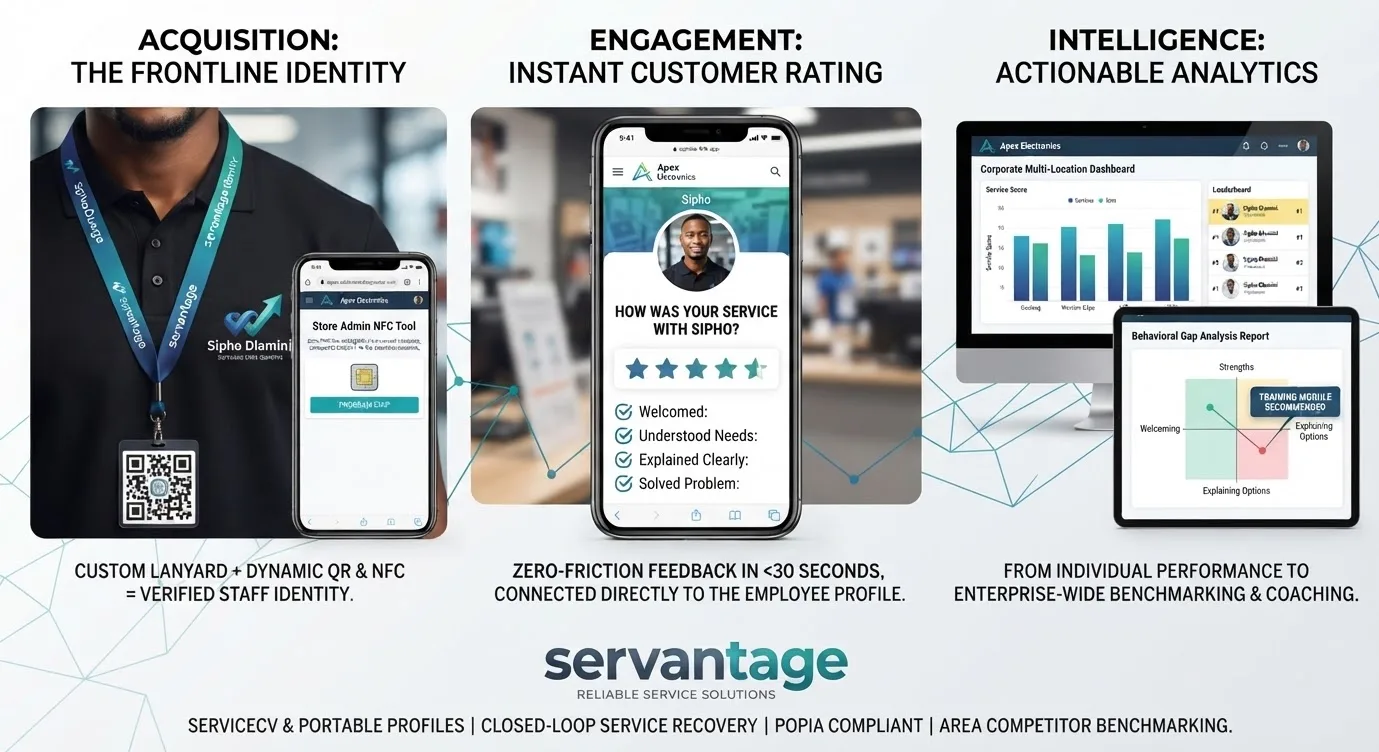
Frontline experience - the missing link
Discover how measuring the frontline staff experience is the missing link to understanding gaps in service delivery pre sale as opposed to post sale.
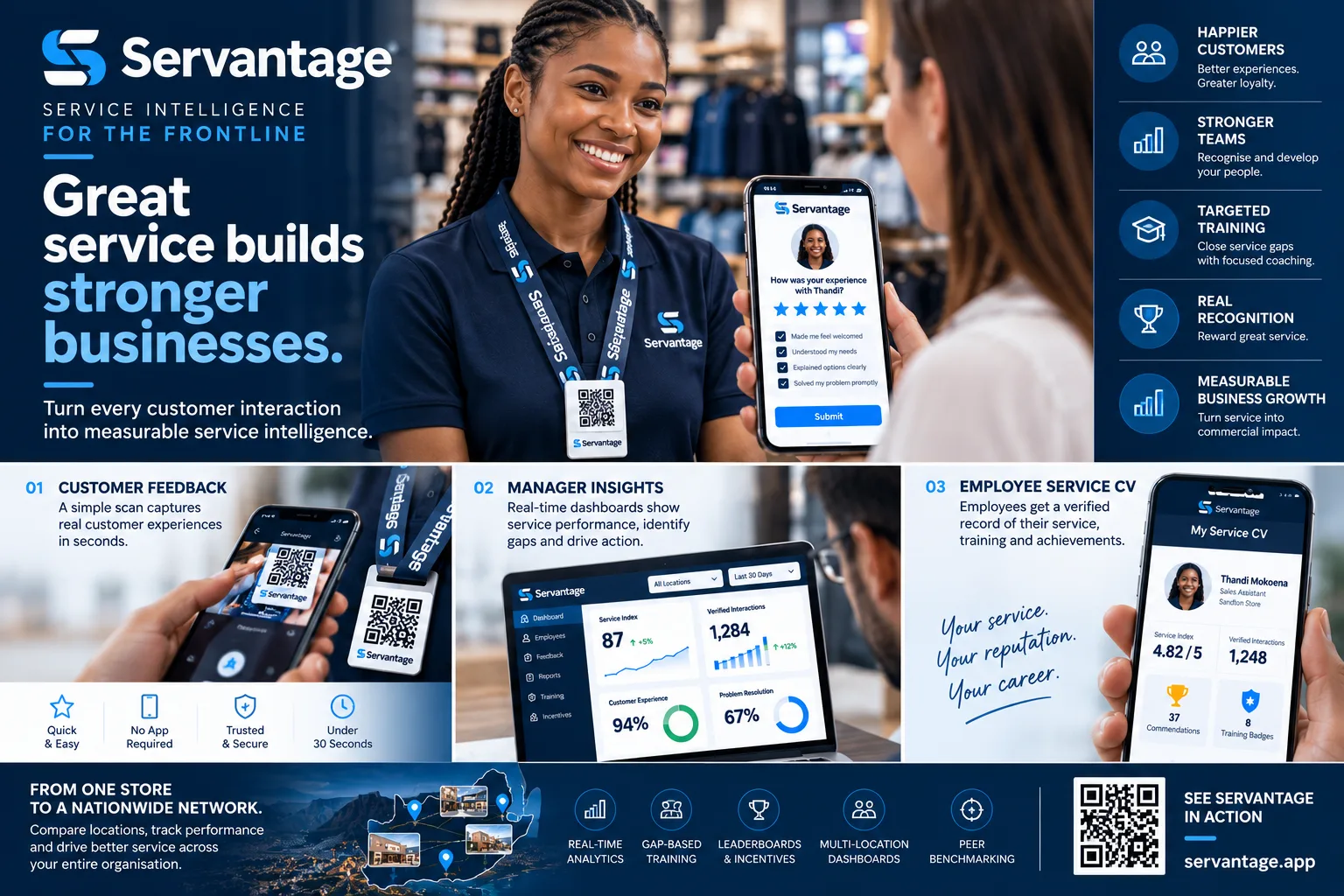
The Frontline Advantage: Why Your Staff Are Your Customer Experience Strategy
Frontline staff are the face of your brand and the decisive factor in customer experience. They turn promises into real service moments—resolving problems, building trust, and influencing loyalty. Yet global research shows the risk: 32% of customers would leave a loved brand after one bad experien